Coffee Break Illustrations
First Impressions: Cozy, Clean, and Quietly Confident
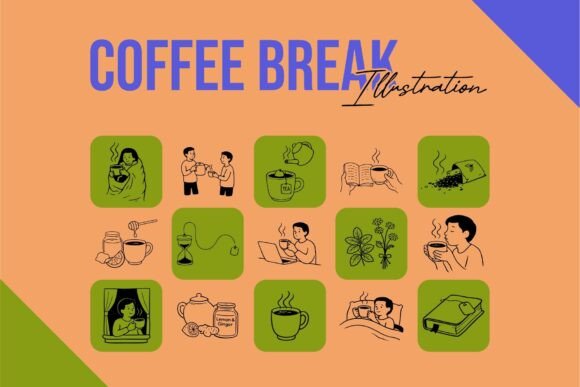
Opening Coffee Break Illustrations feels like stepping into a sunlit corner café—warm, unhurried, and intentionally uncluttered. These 25 hand-drawn minimalist illustrations don’t shout. They invite. Each piece is built on confident line work: soft curves for steam rising from mugs, gentle angles for folded napkins or tilted teacups, subtle asymmetry that reads as human—not algorithmic. There’s no heavy shading, no dense fill areas, no ornate borders. Just clean, intentional outlines with breathing room. That simplicity isn’t minimalism for minimalism’s sake—it’s functional minimalism, tailor-made for embroidery.
A Real Project Test: Embroidering a Linen Tote Bag for a Local Boutique
Last week, I prepped a custom order for a neighborhood gift shop: five linen tote bags, each featuring a different Coffee Break Illustrations motif—a pour-over setup, a stacked mug-and-saucer, a steaming teapot—centered just below the handle seam. Why this collection worked so well here wasn’t just theme alignment; it was structural honesty. The lines are generous enough to hold stitch integrity at 3–4 inches wide (ideal for tote front panels), yet restrained enough to avoid visual weight on lightweight linen. No detail collapsed under satin stitch. No thin stems vanished in fill stitch density. Even the tiniest coffee bean silhouette held up cleanly at 1.2 inches tall—no ghosting, no thread nesting.
Where It Shines—and Where to Pause
Coffee Break Illustrations excels in projects where clarity, warmth, and quiet intention matter most:
- Embroidered patches—clean edges translate directly to crisp cut edges and stable backing;
- Sweatshirt embroidery—the low-detail nature avoids bulk and stiffness on fleece-backed knits;
- Baby embroidery—soft shapes read instantly on onesies and burp cloths without overwhelming tiny proportions;
- Kitchen towels and aprons—line art stays legible after repeated washing and ironing;
- Personalized gifts—a monogrammed mug illustration on a ceramic coaster mockup? Instant charm, zero visual competition.
But let’s be direct: this isn’t a one-size-fits-all embroidery file. Use caution on:
- Curved surfaces like caps—some motifs with longer horizontal lines (e.g., a tray holding three mugs) may distort unless resized and repositioned thoughtfully;
- Thin or highly textured fabrics—like gauzy cotton or bouclé—where fine line work can blur or catch unpredictably;
- Dark fabric without high-contrast thread—these illustrations rely on shape, not tonal depth, so pale thread on navy won’t pop without testing;
- Dense decorative accents—adding French knots or seed stitches around the outlines? Lovely—but only if the original line spacing allows breathing room.
What It Adds to Your Finished Product—Beyond Aesthetics
When customers see an item embroidered with Coffee Break Illustrations, they don’t just register “coffee.” They register care. The handmade product feels considered—not mass-produced, not trend-chasing. That translates directly to perceived value: a $38 embroidered tea towel sells faster than a generic script logo because it tells a micro-story. For Etsy sellers and small shop owners, that story builds trust. It signals you understand your audience’s rhythm—their slow mornings, their shared kitchen moments, their love of tactile, unhurried design. And yes, it works commercially: the consistent visual language across 25 pieces means you can build cohesive branding for a café launch, a wedding favor line, or a holiday capsule collection—all without licensing friction (though always confirm terms before resale).
Practical Notes Every Embroidery Designer Should Run Through
Before stitching your first Coffee Break Illustrations piece into a client project or inventory batch, do these six things:
- Test on scrap fabric—same fiber, same weight, same stabilizer combo you’ll use for the final run;
- Check thread color contrast—especially on light/dark backgrounds; try matte cotton and rayon side-by-side;
- Review stitch density—minimalist doesn’t mean low-stitch-count; some outlines need tight running stitch to avoid wobble;
- Confirm hoop size compatibility—not all motifs scale down gracefully below 2.5 inches without losing definition;
- Inspect small details—like steam curls or spoon handles—at actual stitch-out size, not just on screen;
- Use proper stabilizer—lightweight cutaway for knits, tear-away for stable wovens, and always test wash one sample.
Also: preview your digital embroidery file in black-and-white mockups. If the shape reads clearly without color cues, you’re golden. If it flattens or confuses, adjust spacing or simplify manually before digitizing.
Final Thought: Not Just Graphics—Design Assets With Gravity
Coffee Break Illustrations isn’t filler. It’s foundation. Whether you’re designing a custom embroidered patch for a barista’s apron, building printable mockups for your Etsy listings, or developing a full suite of holiday embroidery files for wholesale craft kits—this collection holds its ground. It doesn’t compete with your voice; it supports it. It gives your handmade product quiet confidence, your custom apparel emotional resonance, and your small business a recognizable, repeatable note of warmth. In a market flooded with loud, over-digitized assets, that kind of restraint is rare—and deeply useful.