10 World Theatre Day Illustrations: Graphics for Brand Storytelling
As a brand designer who’s built visual systems for theatre schools, indie publishers, and creative entrepreneurs, I tested 10 World Theatre Day Illustration in a live campaign—launching a digital workshop series on storytelling for small business owners. The goal? Create warm, human-centered marketing visuals that feel culturally rich but never clichéd. Here’s what stood out—and how it performed where it mattered most.
A First Impression That Speaks Before You Scroll
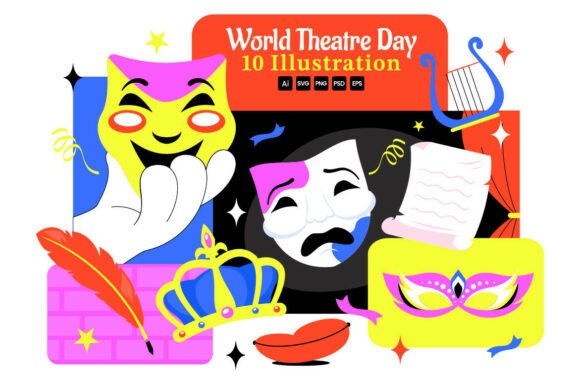
The moment I opened the file, I felt the rhythm: bold red curtains framing expressive comedy and tragedy masks, subtle stage lights, and delicate decorative flourishes evoking vintage playbills. This isn’t generic clipart—it’s a graphic design asset with narrative weight. It lands as premium yet approachable, striking a rare balance between theatrical gravitas and modern warmth. For brands rooted in education, creativity, or community—think online coaches, podcasters, or indie publishers—it signals authenticity without sacrificing polish.
Where It Elevates Real Marketing Workflows
In our workshop launch, we used 10 World Theatre Day Illustration across six touchpoints—and each time, it reinforced brand voice instead of competing with it:
- Social media graphics: Paired with clean sans-serif typography, the illustrations became Instagram carousels and Pinterest pins that stopped scrollers mid-feed—not because they’re loud, but because they feel intentionally composed.
- Email banners & landing page headers: The vector scalability meant crisp rendering at any width. No pixelation, no awkward cropping—just confident visual hierarchy that guided attention to CTAs.
- Printable content kits: As part of a lead magnet bundle (storytelling worksheets + mood boards), the illustrations added thematic cohesion without overwhelming text-heavy pages.
- Editorial design: Used as section dividers in a blog post about “Theatre Principles for Better Client Presentations,” it elevated tone without distracting from copy.
- Canva templates: Dragged into branded Canva templates, the SVG files retained editable layers—ideal for designers building reusable assets for clients or courses.
- Packaging accents: For limited-edition physical workbooks, we printed one mask motif on the spine—subtle, memorable, and instantly recognizable as part of our visual language.
What It Does for Brand Perception—Beyond Aesthetics
This isn’t just decoration. 10 World Theatre Day Illustration builds audience trust by signaling cultural fluency and emotional intelligence. When your brand uses thoughtful, context-aware design assets, people subconsciously register: *This creator understands nuance. They care about craft.* That translates directly to stronger recognition, better engagement, and more memorable campaign visuals—especially for audiences who value storytelling, education, or artistic expression.
Best Fit Scenarios for Stronger Visual Impact
Use this illustration set where you need instant thematic resonance and emotional texture:
- Hero graphics for seasonal offers tied to creativity, performance, or self-expression
- Campaign headers promoting workshops, webinars, or coaching programs about communication
- Branded templates for content creators selling Notion dashboards or Canva kits
- Social media covers for theatre studios, writing communities, or arts nonprofits
- Content bundles and digital product visuals—especially for storytelling, public speaking, or branding courses
- Promotional banners for festivals, local events, or hybrid (online + in-person) experiences
Where to Proceed with Intentional Design Judgment
While versatile, 10 World Theatre Day Illustration isn’t universal. Use carefully in:
- Formal corporate branding (e.g., financial services or legal firms)—its expressive tone may clash with expectations of austerity
- Dense information layouts (like comparison tables or feature grids)—the motifs can compete with data clarity
- Small mobile graphics (e.g., app icons or notification banners)—details like curtain folds or mask textures lose legibility under 64px
- Overly minimal brands relying on negative space and monochrome palettes—the reds and contrasts may disrupt tonal harmony
- Text-heavy ads where visual simplicity is key to message retention
Pro Designer Notes You’ll Want to Run Before Going Live
Before dropping this into client work or a paid campaign, run these checks:
- Test against your brand color palette: Does the signature red harmonize—or does it demand a palette refresh?
- Check black-and-white usage: Print a test flyer. Do masks retain definition? Do curtain lines hold contrast?
- Place inside real mockups: Drop it into a website header, Instagram story, and email banner—then step back. Does it anchor or distract?
- Preview on mobile screens: Especially in landscape orientation. Are focal points still clear at 375px width?
- Test readability in small sizes: At 24px font size next to the illustration—does hierarchy stay intact?
- Compare against competitor visuals: Does it differentiate your offering—or blend into expected tropes?
- Pair with fonts: Try serif (for editorial gravitas), sans-serif (for modern clarity), script (for handwritten warmth), and display fonts (for bold campaign energy). Note where balance shifts.
- Review spacing and balance: Does the composition breathe—or feel crowded when scaled down?
- Confirm commercial licensing: Verify permissions for client deliverables, digital products, and paid ads. This is a commercial design asset—but always double-check scope.
Why It Belongs in Your Creative Marketplace Toolkit
For small business branding, 10 World Theatre Day Illustration delivers more than decoration—it delivers context. In a saturated digital landscape, audiences respond to visuals that carry meaning, not just style. Whether you’re designing packaging for an artisanal journal, building a content marketing kit for performers, or launching a digital product about emotional intelligence, this set brings layered resonance. It’s a modern design solution that respects tradition while serving today’s creative marketplace needs—without demanding complex customization or sacrificing professional branding standards.